


Hardie Gramatky, N.A. Biography
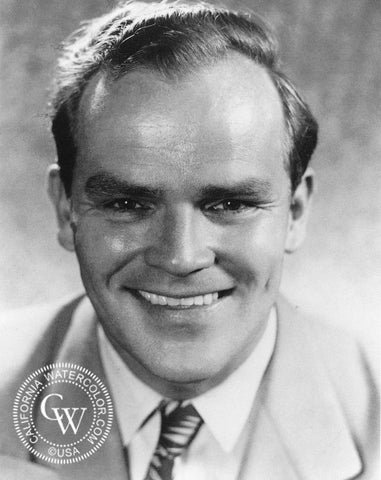 Hardie Gramatky, N.A. (1907-1979) Born: Dallas, TX; Studied: Stanford University, Chouinard Art Institute (Los Angeles); Member: National Academy of Design, New York Water Color Club, American Watercolor Society, California Water Color Society. Hardie Gramatky was raised in Southern California. He studied art with F. Tolles Chamberlin, Clarence Hinkle, Pruett Carter and Barse Miller. A dedicated student of watercolor painting, he produced an average of five small watercolors per day. By 1929, he had become a proficient watercolorist and was recognized as one of the true innovators in the development of California Style watercolor painting. These skills helped him to get a job as a head animator at the Walt Disney Studios.
In the early 1930s, he became active on the board of the California Water Color Society and it was largely through his aggressive moves that the California School of watercolorists was able to take control of the Society and expand it into a nationally recognized organization. In 1937 the Ferargil gallery became his art agent in New York City and began selling his watercolors. He also exhibited works in other cities in America and established a reputation as one of California’s premier watercolorists.
By the 1940s, he was producing commercial art to be used for magazine illustrations and began writing and illustrating a series of children’s books. Hercules, Loopy, Creeper’s Jeep and Sparky were all books he created, but Little Toot was the one that would become an all-time best seller. During World War II, he worked in Hollywood producing training films for the United States Air Force and after the war moved back to the East Coast.
Settling in Connecticut he pushed a career as a commercial illustrator producing art for Fortune, Collier’s, Woman’s Day, True, American and Readers Digest. From the 50’s on, he concentrated exclusively on fine art painting and writing and illustrating children’s books. His last book was published posthumously in 1989.
CaliforniaWatercolor.com is pleased to offer giclees of illustrations from Gramatky's classic childrens book "Little Toot" for the first time anywhere. Now parents, grandparents and teachers can purchase high-quality prints of the illustrations from the restored edition of "Little Toot" published in 2007. The publisher and Linda Gramatky Smith rescanned the original artwork so that it has the freshness, bright colors, and vibrancy of the first edition published in 1938 (which had been in print continually for 68 years). This edition has been lavishly praised on NPR by Daniel Pinkwater, and a Barnes & Noble and Amazon best-Seller. To see the Little Toot giclees, go to prints 62 - 77 for fifteen selections from the delightful book.
Biographical information:
Interview with Dorothea ("Doppy") Gramatky, 1983, and interview with Linda Gramatky Smith, 2008.
Biography courtesy of California Watercolors 1850-1970,
©2002 Hillcrest Press, Inc
California Watercolor
Watercolorist Ranked Among America's Best
By Frances Moore
Westport News
Article Launched: 12/06/2006
Westporters may remember him as the amiable artist who lived on Roseville Road for many decades. Parents may know him as the creator, author and illustrator of the Little Toot children's books (and subsequent videos). But to the art world, Hardie Gramatky is considered one of the great American watercolorists. That might be a subjective statement, but a recent recognition by one of the medium's masters, Andrew Wyeth, all but makes it a fact. In the 20th anniversary issue of Watercolor Magazine (fall 2006), the revered Wyeth placed Gramatky among the top 20 great American watercolorists.
"That is a very large honor from a very large person -- from a person who knows what he's looking at," said Howard Munce, a Westporter and well-known artist in his own right. "It's like the hall of fame."
According to critics and peers, Gramatky's work is different than anything else that had been done before. "His style was an original style. It was smashing contrasting colors," said Munce. "Watercolor is one of the most difficult mediums you can work in. He had that mastered."
A large part of Gramatky's life was spent in Westport, and many of the scenes depicted in his paintings were of his surroundings. A lot of changes have occurred in town since he died in 1979, so many of the local areas in his paintings are mere ghosts of the streets and beaches we see now -- some require a bit of imagination to match the now with then.
Paintings like "Turkey Hill" and "Old Mill Pond" are self-descriptive. Others featured scenes from his neighborhood on Roseville Road, like "Linda in Front Yard," "Country Road" and "Evening Quiet." Compo Beach was another popular site for Gramatky's paintings, with works like "Beach at Compo Sunset," "The Fisherman" and "Holiday."
His daughter, Linda Gramatky Smith, now lives in her parents' house on Roseville Road. When her mother, artist Dorthea "Doppy" Cooke Gramatky, died in 2001, Smith and her husband, Ken, took over the management of Gramatky's estate.
"Part of what made my dad so unusual [is] so often there's something happening in my dad's paintings. It's not just a scene -- there's something going on there," Smith said.
His use of color and treatment of light are what makes a Gramatky painting a Gramatky painting.
"I met the Gramatkys when I was I was in my late teens, they were friends of my wife's family. Hardie and Doppy were two of the nicest people I've ever met," said Will Rowlands, editor of the Westport News. "I was blown away when I walked into their livingroom and saw 'Moon Magic' hanging on the wall. His treatment of light is enchanting."
In a 1947 article called "The Watercolor Series," featured in American Artist, Gramatky was quoted as saying, "In my art student days, I was tremendously influenced by that sunlight painter, van Gogh. So much so that I spent most of my days outdoors, painting everything from the seacoast to the desert."
And he did paint just about everything. During one three-year period, Gramatky painted an average of five watercolors a day.
"My theory was a simple one," he said in the 1947 American Artist article. "I figured that the more you painted the more of a master of your medium you became; so that when you really had something to say, you said it directly, without having to consider the medium. My idea was to play my palette like a pianist plays a keyboard: never conscious of reaching for color or tone, but getting the most subtle shades of harmony with the greatest of confidence."
Though best known for his work in watercolor, Gramatky had talent in other areas as well, such as writing, illustration and animation. In fact, he got his start in those three fields.
Gramatky was born in Dallas, Texas, on April 12, 1907. After his father died in 1917, the family moved to South San Gabriel, Calif. Growing up in California put Gramatky literally in the right place at the right time -- the world of watercolor began utilizing the seaside scenes of the sunny West Coast to challenge the European artists who dominated the art scene at that time.
After high school, he headed to Stanford University, where he majored in English. While taking art classes there, a professor realized Gramatky's talent and encouraged him to transfer to Chouinard, a respected art school, to further his training. While at Chouinard, the energetic artist attracted the attention of his future wife. He also began working for an up-and-comer named Walt Disney, whose new character Mickey Mouse had just caught America's attention with the release of the film Steamboat Willie.
Gramatky stayed on at Disney after his schooling finished, and worked as an illustrator for some of the Mickey Mouse comic books. Always being a fast worker, he made time in his schedule to learn animation as well. He also found the time to get married in 1932. He signed a six-year contract with Disney, making $150 a week -- an equivalent of roughly $100,000 by today's standards. So when the stock market crashed in 1929, Gramatky was relatively unscathed.
"My folks were never opulent, they were just grateful for each other and grateful for being able to paint," Smith said. "They didn't have to experience that 'Brother Can You Spare a Dime'-type of life."
But working at Disney for the rest of his career wasn't really what Gramatky had in mind -- he had his own ideas, and wanted to make a name for himself. New York, he felt, was the place to be. He left Disney in 1936 with two letters of recommendation from Walt, which Gramatky never had to use. Disney would crop up again in Gramatky's life, but for the time being, Gramatky and his wife started a new life and new careers in New York. They began working as pictorial reporters and commercial illustrators for various publications -- Gramatky began at Fortune magazine, and Doppy at King Features. Then Colliers called -- a top-notch publication of the day. At this point, he finally felt some job security.
One day while Gramatky was watching the boats on the East River, he got an idea. According to his daughter, he wrote in his diary on Jan. 12, 1938, "IDEA -- do children's book on East River -- little boats as characters. Sketch character in them each day -- chesty little tugs pulling a big load."
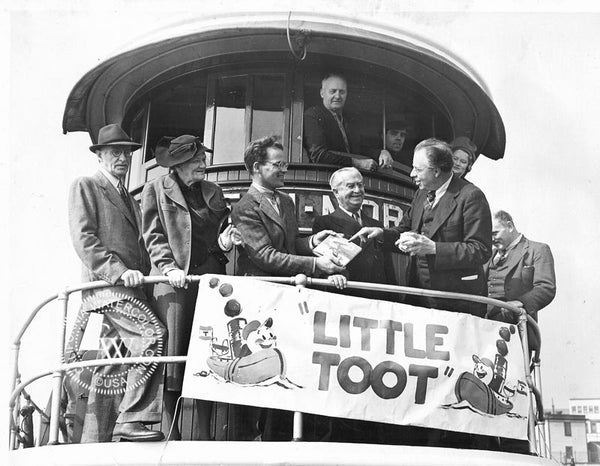
Little Toot began to take form that year -- Gramatky would draw sketches and paint watercolors of tug boats, and began writing a story of a tug boat that would always get into trouble. After turning his work into a manuscript, Putnam eventually agreed to publish the book, Little Toot, which would go on to become an all-time best-seller, and Little Toot's worldwide travels would be documented in sequels, like Little Toot Through the Golden Gate and Little Toot in Venice. The books remain popular -- a restored edition of the book is due for release in 2007.
Unfortunately, Little Toot also unearthed one of the more seedy sides of the art business. The popularity of the Little Toot series attracted outside parties who were interested in animating and merchandising the little tug, namely the Walt Disney Company. Gramatky sold the rights to Disney, but never received any royalties for the merchandise, recordings or videos that were sold over the years.
"He [Gramatky] was such an honest person, he believed other people would be, too," Smith said. "My dad really saw Walt Disney as the father he never had He [Gramatky] was not a business man; he wasn't tough. He really trusted Walt Disney, but Walt passed everything over to Roy Disney." (Roy was Walt's older brother who acted as CEO and president of Disney, and was credited for handling its finances -- Walt usually handled the creative aspect.)
Despite that, the Gramatky family was never really in dire straights, financially. "My dad was so lucky because you never get rich with children's books, but the royalties would dribble in. Then he'd sell a piece, which would give him a chance to get the next book started," Smith said.
Though he was unable to enlist during World War II due to a curvature of the spine, he moved back to California briefly to supervise the production of training films for the U.S. Army Air Forces, under Capt. Ronald Reagan. Years later, during the Vietnam War, he again offered his services, flying to Vietnam as an artist-correspondent.
The Gramatky family moved to Westport in 1946. He continued to submit illustrations and paintings for publications in New York, and to imagine new adventures for Little Toot. He also joined forces with other local artists Walter DuBois Richards and Stevan Dohanos to create the Fairfield Watercolor Group. The three would invite nine other artists to join them once a month at one member's house. Each month the members would have to bring a new work with them to be examined and criticized by their peers. Eventually, Munce was invited to join the group.
"The main thing is that it forced you to do a painting a month, at least. If you were a commercial artist, you were used to deadlines. But this was a deadline above and beyond. The only person you had to answer to was yourself," Munce said.
Smith explained, "They would critique each other -- it would really never be hurtful. But at the same time you have 11 of your peers giving you ideas."
Gramatky also got feedback at home from his artist wife. "He valued her feedback incredibly I think it was really important to have another artist in the house to run things by," Smith said.
She said that her father really loved children and enjoyed working with them. Some may remember Gramatky's "Chalk Talks," which he gave at local elementary schools. He was also invited to other schools around the United States to give similar talks, including one back in his birthplace of Dallas, Texas, in 1979.
He encouraged the children to create for themselves. "What you've got to realize when you're an artist, this is the first time in your life that you're the boss You can put birds in the sky or you can put fish in the sea, or you can reverse it," he instructed.
By all accounts, Gramatky was sort of the Jimmy Stewart of the art world -- a master of his craft, highly regarded by his peers throughout his long career, yet genial, gentle, unaffected by fame and down-to-earth.
"He really was very humble," Smith said. "Someone would come up and say, 'My child wants me to read Little Toot 10 times a night.' It was like that was the first person that ever told him they loved Little Toot."
Smith said that he was always incredibly grateful whenever he was honored by the various societies. Just before he died of cancer, Gramatky found out that he was to receive the High Winds Medal from the American Watercolor Society. The morning of the ceremony, he collapsed and died shortly after.
"I went to New York for the dinner," Smith explained. "Part of me thinks that he was really holding on for that, it was so special."
Similarly, Munce agreed that Gramatky would have been incredibly honored to be mentioned by Wyeth.
"He would have jumped in the air, I'm sure," Munce said.
As for Wyeth, his family's name has been familiar to art lovers since the early part of last century, beginning with N.C. Wyeth, an illustrator and artist. His son, Andrew, surpassed his father's fame. His paintings can be found at The Metropolitan Museum of Art, the Whitney Museum of American Art and the Museum of Modern Art, all in New York City, as well as the Smithsonian American Art Museum and the White House. He received the Presidential Medal of Freedom from President John F. Kennedy in 1963 and the Congressional Gold Medal of Honor from former President George H.W. Bush, among many, many other honors. Watercolor Magazine described him as "the man who shaped American watercolor for more than 60 years."
Even those who aren't among the art world's elite may remember the Andrew Wyeth painting that Snoopy couldn't part with in Charles Schultz's Charlie Brown comic strip. Wyeth's work also inspired M. Night Shyamalan's The Village and the look for the American version of The Ring.
Though the two never met, Gramatky and Wyeth were fans of each other's work throughout their careers.
Smith remembered, "My dad just loved Andrew Wyeth paintings, but several times he went down to the Brandywine Museum [where a large collection of Wyeth's work is on display]. I don't think he ever would have thought to say, 'Can I stop by and meet you?'"
Nevertheless, it's likely that had the two met, they would have become fast friends, if for nothing else, than for the love of their art.
"He [Gramatky] was a lovely man and he was dedicated to art," Munce said. "I couldn't think of a better honor. I'm very impressed and delighted."
California Watercolor

Andrew Wyeth Picks 20 Great American Watercolorists 13 Mar 2007 by American Artist
The man who has shaped American watercolor for more than 60 years identifies the historic painters who have made the most of the medium.
by M. Stephen Doherty
When I first proposed to Andrew Wyeth that he compose a list of 20 artists he considered to be among the greatest watercolorists, he considered both contemporary and historic practitioners. “He’s concerned that limiting the list to historic figures would make it too short; and that adding contemporary painters would make it too long,” said his curator, Mary Landa. “He also worries about offending some good watercolorists he might not think about.” I suggested he focus on historic painters and consider a long list I put together. By the time I visited Wyeth’s home in Chadds Ford, Pennsylvania, in early March, he was feeling more confident about finalizing a list that would suggest to Watercolor readers what he felt was the hallmark of a great watercolor.
The final list of 20 great painters includes those who elevated the importance of watercolor and helped define a distinctly American attitude toward the medium, as well as artists who are less well known yet offer a uniquely expressive approach to working with combinations of water-soluble paints. The selection includes some obvious choices that would be on almost anyone’s roster—such as Winslow Homer and John Singer Sargent—as well as artists such as William Thon, Hardy Gramatky, and Morris Graves, who reflect Wyeth’s age, experience, and attitude. For example, he knew and admired several of the artists who shared his interest in expressive representation; and, in contrast, he felt no particular affinity with the Abstract Expressionists or the Photo Realists who painted in watercolor at roughly the same time he was working with the medium.
The point in formulating this list is to offer a broader view of watercolor than many people would associate with Wyeth. People often form the mistaken opinion that he gravitates toward the sentimental, pastoral, or nostalgic; but a review of the vast number of watercolors he has created since the late 1930s reveals that he is often captivated by the power of nature, the transience of life, the juxtaposition of animate and inanimate forms, and the ability of watercolor to represent the soul of the artist. Those are often the qualities he admires in other artists’ paintings.
It is clear that no other contemporary artist has influenced the ways painters use watercolor as much as Wyeth. His paintings have been so widely exhibited and reproduced over the past 60 years that almost every watercolorist has been influenced by him, either directly or indirectly. That influence may come from direct experience, through teachers or fellow artists, or through collectors who measure every watercolorist against Wyeth. Many artists have emulated the subject matter of his paintings, his palette of colors, his penchant for detail, his orientation toward personal themes, or his willingness to express individual perceptions.
Anyone who has enjoyed such unprecedented success and had such a pervasive influence on generations of artists might be excused if he were arrogant, aloof, or remote. After all, celebrities in other fields are notoriously demanding. But despite his fame, wealth, and influence Wyeth is much the same person he was when he mounted his first exhibition of watercolors in 1938 at the age of 20. He remains a personable, caring, and appreciative man who is just as excited about the freedom afforded by watercolor as he was when his father first encouraged him to use the paints. Even with a major retrospective at the Philadelphia Museum of Art (“Andrew Wyeth: Memory and Magic,” March 29 through July 16, 2006), an exhibition of his drawings at the Brandywine River Museum, in Chadds Ford, Pennsylvania (“Andrew Wyeth: Master Drawings From the Artist’s Collection,” March 11 through July 16, 2006), Wyeth is still most excited when sitting on the ground with a stack of watercolor paper in his lap, brushes and paints laid out by his side, and a tree or a figure posing in front of him.
Wyeth made similar comments about watercolor when writing about the paintings reproduced in a book titled Andrew Wyeth Autobiography (Bulfinch Press, New York, New York). “The only virtue to it is to put down an idea quickly without thought about what you feel at the moment. It’s one’s free side. Watercolor shouldn’t behave,” he commented in reference to Half Bushel, a painting of a basket lying under an apple tree, created in 1959. “You’re in the lap of the gods—almost like painting with your eyes half-closed.” “Sometimes I don’t want to see too clearly,” he wrote in reference to another watercolor. “You build up a kind of color that is purely an interpretation of the truth. Anything to get away from the predictable. This applies to the design of a picture too. Painting is all about breaking the rules. Art is chance.”
Wyeth was introduced to watercolor by his father, the famous illustrator N.C. Wyeth, and by one of his father’s friends, Sid Chase. He immediately began looking at the work of great watercolorists from the past, especially American artists who “lifted watercolor from the academic approach of the British and made it something freer,” he explained to me. Among the first historic artists to inform and influence young Wyeth was Winslow Homer (1836–1910), whose work he first saw when visiting Homer’s studio in Prouts Neck, Maine. “I never wanted to copy the work of other people, but I wanted to find the truth in nature that they were expressing—and then find my own truth,” he is says in the book Andrew Wyeth: Early Watercolors, by Susan Strickler (Currier Museum of Art, Manchester, New Hampshire). “So Homer led me on to something else. I got a direction that was authentic to me and to what I felt.”
As his interest in watercolor expanded, so did Wyeth’s awareness of other great artists who used the medium, particularly those who used it as freely and expressively as he did. He was especially interested in those who had developed a personal style and expanded their range of possibilities. He met many of those artists, such as Edward Hopper, during trips to New York or summer excursions to Maine; and a number of others called on him in Chadds Ford, Pennsylvania.
The enthusiasm that Andrew and Betsy Wyeth have for American painting is demonstrated through their foundation, The Wyeth Foundation for American Art. The foundation provides substantial support for exhibitions, catalogues, research, and acquisitions of American art. The Wyeths have also donated works from their personal collection to museums, and they have made plans to leave their home and property to the Brandywine River Museum.
And the list that Andrew Wyeth came up with March 2006?
1. Milton Avery (1893-1965)
2. Charles Burchfield (1893-1967)
3. Charles Demuth (1883-1935)
4. Arthur Dove (1880-1946)
5. Thomas Eakins (1844-1916)
6. Hardie Gramatky (1907-1979)
7. Morris Graves (1910-2001)
8. Childe Hassam (1859-1935)
9. Winslow Homer (1836-1910)
10. Edward Hopper (1882-1967)
11. Georgia O’Keeffe (1887-1986)
12. John Marin (1870-1953)
13. Reginald Marsh (1898-1954)
14. Thomas Moran (1837-1926)
15. John Pike (1911-1979)
16. Ogden Pleissner (1905-1983)
17. Maurice B. Prendergast (1859-1924)
18. John Singer Sargent (1856-1925)
19. Millard Sheets (1907-1989)
20. William Thon (1906-2000)
Hardie Gramatky-Author and Illustrator-notes by his daughter, Linda Gramatky Smith
Little Toot (1939)

This classic story of a New York City tugboat (actually a Moran tugboat that Dad saw out his studio window) has received the Library of Congress award, been a float in the Rose Bowl parade, and made into an animated movie (“Melody Time”) by Walt Disney. Over 6 million copies of the Little Toot books have been sold, and in 2007 G. P. Putnam (part of the Penguin Putnam Group) published a Restored Classic Edition that brought back the original vibrant red and blue colors and the endpapers of the original first edition.
The Treasure Hunter: The Story of Robert Louis Stevenson (1939, illustrator only)

Dad did wonderful black-and-white illustrations for this 206-page young-adults book written by Isabel Proudfit. Good friends, Don & Barbara Elleman, are going on a trip to the island of Apia, and it was fun to read about it in this biography of Stevenson, who made on this South Seas island a replica of an English manor house and property.
Hercules (1940)

The story of the old-fashioned fire engine was a popular book in the 40s and 50s (when "Captain Kangaroo" used the animated Weston Woods film frequently on his TV show). Children loved it when my dad would do chalk drawings from the book when he went out to schools and libraries.
Skwee-Gee (1940, illustrator only)

The story of a "most un-ordinary teddy bear" who is left by his owner in the mountains and finds a way to get back home. The picture book was written by Darwin and Hildegarde Teilhet, and my father's original illustrations reside in the New York Public Library collection.
Loopy (1941)

Loopy was a small airplane called a hedgehopper. He wanted to fly without a pilot, and after a scary adventure, he proved himself and became a skywriter, a very careful one.
Creeper's Jeep (1948)

The first book Dad wrote after we moved to Westport, CT, in 1946, it was based on a real farm family across the street from us, Gertie and Louie Gampfer. Of course the way the son’s shiny jeep came alive and did all his chores for him came from Dad’s imagination, but it’s a great story of how the jeep redeemed himself. (1948)
Sparky (1952)

Sparky is a trolley car that can’t keep his mind on his work. He gets into trouble but then one heroic act makes up for all the wrongs he has done. This is a very popular book in Japan and sold over a quarter of a million books when it was first published in the 70s. It (and three other Gramatky books) were republished in 2005 in Japan.
Homer and the Circus Train (1957)

This book demonstrated for me how clever Dad was with puns and word games, because this darling caboose who “sees the world backwards” from the end of the train had a new way of looking at things. He read the sign “Stop, Look & Listen” as “Netsil & Kool Pots”! And when Dad wrote about Homer being scared when a tall trestle bridge began to shake, he was remembering his own experience as a young boy in Dallas, TX. When he was seven, he had to go over a trestle bridge and far out of town to get fresh milk for his father sick with tuberculosis.
Bolivar (1961)
Dad was chosen as an artist for the Air Force and went down to Ecuador with Walter DuBois Richards and Al Munchen to paint watercolors of Air Force planes. He fell in love with Quito and heard all about its famous South American hero, Simon Bolivar, and thought up the story of a burro named Bolivar who tries so hard to live up to his illustrious name.
Nikos and the Sea God (1963)

My parents went over to Greece to see old friends who used to live in Connecticut, and they fell in love with Greece. This was one of Dad’s favorite books because he had always loved Greek myths and wanted to share them with American children. Meet Nikos and his Aunt Mara and his pelican, Icarus.
Little Toot on the Thames (1964)

When I went away to Bates College, my parents were free to travel as well. (I was an only child.) They went to London and Dad started to think that perhaps Little Toot would like to see new places as well. This book was the first sequel to his original Little Toot and one of my favorite illustrations is the page 27 with Little Toot in front of the Tower of London. And can you believe that the Queen herself helps him find his way home?
Little Toot on the Grand Canal (1968)

On a trip to Venice, Dad and Mom loved seeing the Bridge of Sighs and imagined how Little Toot would love the bubbles the glassblowers blew. My favorite illustration in this book is page 19, where Little Toot is watching enthusiastically the huge candystick canes he thought looked delicious.
Happy's Christmas (1970)

When I was growing up, we had a beagle named Lucky and she had a litter of pups. This story grew out of a true story (embellished a bit) about a school teacher who adopted one puppy but found he was bored during the day and chewed some electrical cords. She called up to ask, “Mr. Gramatky, would you take the puppy back? I love him but this life isn’t fair to him.” So we did, and we had Happy until he died of old age.
Little Toot on the Mississippi (1973)

My parents traveled in the United States as well, and they loved the bayous of this wonderful river, but when it begins to flood, Little Toot sets out on a daring rescue! Everyone loves the personification of the old steamboats and paddle wheelers who floated down the river.
Little Toot Through the Golden Gate (1975)

My parents made a nostalgic trip out to San Francisco and then down the coast (Dad painting several prize-winning watercolors) to see longtime friends in Carmel and his brother in Los Angeles. I think Dad really captured the “painted ladies”, those wonderful Victorian houses on page 23 that look down on San Francisco Bay.
Little Toot and the Loch Ness Monster (1989)

When my father died in 1979, one of the last things he did creatively was to ask me if I knew dictation so that I could "take down the final version of the Loch Ness book" that he had been lying there thinking about. So Mom and I knew how important that book was to Dad. After he died and we showed the manuscript sketches to Putnam, editor and president of Young Reader Books, Margaret Frith, said that "Hardie's sketches are more finished than some illustrators' final art" and we decided to one day try to finish the book. My mother added a couple of illustrations (she was a published artist herself) and I edited all the manuscripts into a final book. The reviews were good, and character actress and producer Shelley Duvall turned the book into an animated feature of her Bedtime Stories show on Showtime. The show even got an Emmy nomination, so we felt that Dad would have been happy with the results.